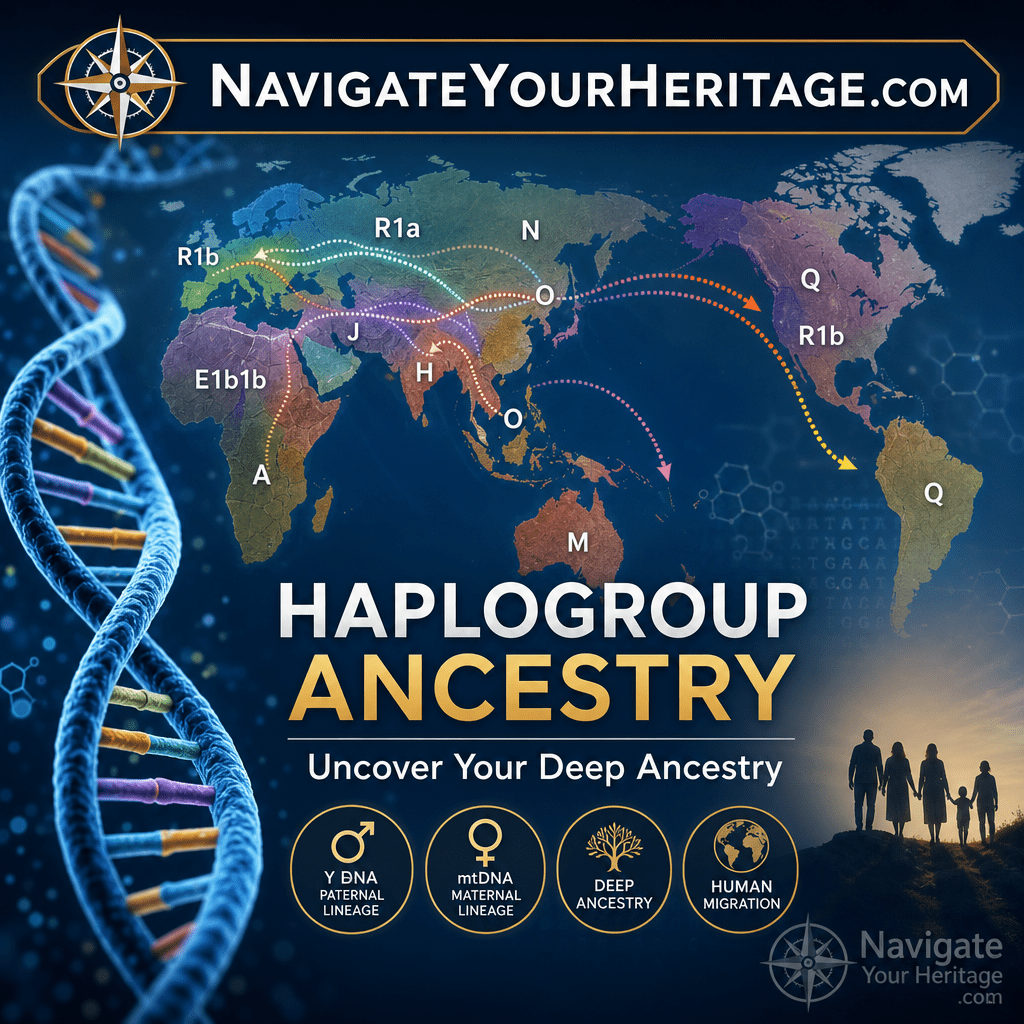
When people first step into the world of genetic genealogy, they often expect a simple answer about where their ancestors came from. What they discover instead is a layered and surprisingly elegant system of markers, mutations, and ancient lineages that stretch back tens of thousands of years. At the heart of this system are haplogroups. These are the genetic branches that define our deep origins and connect us to the earliest humans who walked the earth. Understanding haplogroups is one of the most powerful ways to understand not only who we come from but how humanity itself spread, divided, and evolved.
A haplogroup is essentially a genetic clan. It is a label given to a group of people who share a common ancestor far back in time. These groups are defined by specific mutations that occur in our DNA. When a mutation happens and is passed down through generations, it becomes a marker that scientists can use to trace a lineage. Over thousands of years, as humans migrated, settled, and adapted to new environments, new mutations appeared. Each one created a new branch on the human family tree. This is how haplogroups form. They are the result of countless generations of small genetic changes that accumulate over time.
There are two major haplogroup systems used in genealogy. One is based on the Y chromosome, which is passed from father to son. The other is based on mitochondrial DNA, which is passed from mother to all her children. These two systems give us two very different but complementary views of our ancestry. Y DNA tells the story of your direct paternal line. Mitochondrial DNA tells the story of your direct maternal line. Together they form the bookends of your genetic heritage.
Y DNA haplogroups trace back to what is often called Y chromosomal Adam. This is not a single man who lived alone or the only man alive at the time. Instead, he is simply the most recent man from whom all living men today descend on their direct paternal line. He lived roughly two hundred thousand to three hundred thousand years ago in Africa. Over time his descendants spread across the world. As they did, new mutations appeared on the Y chromosome. Each mutation created a new branch. These branches became the Y haplogroups we use today. When you take a Y DNA test, you are essentially finding your place on this massive branching tree.
Mitochondrial DNA works the same way but follows the maternal line. All humans today descend from a woman known as mitochondrial Eve. Like Y chromosomal Adam, she was not the only woman alive in her time. She is simply the woman whose mitochondrial line survived through all daughters and their daughters until today. She lived around one hundred fifty thousand to two hundred thousand years ago, also in Africa. As her descendants spread across the world, new mutations appeared in mitochondrial DNA. These became the mtDNA haplogroups. When you take a full mitochondrial DNA test, you discover which branch of Eve’s line you belong to.
One of the most fascinating aspects of haplogroups is how new branches form. Every time a mutation occurs in the Y chromosome or mitochondrial DNA and is passed down to future generations, it creates a new lineage. If that lineage survives long enough and spreads widely enough, it becomes recognized as a new haplogroup or subclade. This is why modern testing continues to refine and expand the haplogroup tree. New tests, especially high resolution ones like the Big Y test, are constantly discovering new mutations that were previously unknown. These discoveries add new branches to the tree and help us understand human migration with greater precision.
This is where the difference between basic DNA tests and deep dive tests becomes important. Autosomal DNA tests, like those offered by Ancestry or 23andMe, are excellent for finding relatives within the last few generations. They look at the mixed DNA you inherit from all your ancestors. But autosomal DNA becomes diluted with each generation. It is not designed to trace a single line back thousands of years. That is where Y DNA and mtDNA come in. They do not recombine. They stay almost unchanged from generation to generation except for the occasional mutation. This makes them perfect for deep ancestry.
A basic Y DNA test or mitochondrial test can give you a broad haplogroup. But a full mitochondrial sequence test or a Big Y test takes you much deeper. These tests read your DNA at a much higher resolution. They identify the exact mutations you carry and place you on the most precise branch of the haplogroup tree. This can reveal migration paths, ancient origins, and connections to specific populations or historical groups. It can also help you connect with distant cousins who share the same deep lineage.
The Big Y test is one of the most advanced tools available for paternal lineage research. It sequences the most informative parts of the Y chromosome and identifies both known and newly discovered mutations. When enough people test, scientists can determine when a new mutation occurred and how it spread. This allows them to estimate when a particular branch formed and where it likely originated. For genealogists, this can break through brick walls, confirm or disprove family stories, and connect you with others who share your paternal line. For the scientific community, Big Y data helps refine the human Y chromosome tree and improves our understanding of human migration.
Full mitochondrial DNA sequencing works the same way for the maternal line. It reads all sixteen thousand base pairs of mitochondrial DNA and identifies every mutation you carry. This allows scientists to place you on the most precise maternal branch. It also helps researchers understand how maternal lineages spread across the world. Many mtDNA haplogroups are associated with specific regions or ancient populations. Some trace back to Ice Age refuges. Others trace back to early farmers or hunter gatherers. Full mtDNA testing helps uncover these stories.
Both Big Y and full mtDNA testing contribute to science in ways that go far beyond personal genealogy. Every new test adds data to the global database of human genetic variation. This helps researchers refine timelines, understand ancient population movements, and identify previously unknown branches of the human family tree. It also helps anthropologists and geneticists understand how humans adapted to different environments. Some haplogroups are associated with high altitude adaptation. Others with cold climates. Others with ancient migrations across oceans or deserts. Each test adds another piece to the puzzle.
For individuals, these tests offer something more personal. They provide a sense of identity that stretches far beyond written records. Most people can only trace their family tree back a few hundred years. But haplogroups allow you to trace your lineage back thousands of years. They connect you to the earliest humans who carried your line forward. They reveal where your ancestors lived, how they migrated, and how their descendants eventually became you. There is something powerful about knowing that your paternal or maternal line survived every challenge, every migration, every hardship, and every generation for tens of thousands of years. It is a reminder that your story is part of something much larger.
Haplogroups also help explain why people with the same surname may not share the same paternal line. Surnames are relatively recent. They only go back a few hundred years in most cultures. But Y DNA goes back thousands of years. If two men with the same surname have different Y haplogroups, it means their paternal lines are not related. This can reveal adoption events, name changes, or non paternal events in the family tree. On the other hand, if two men share the same haplogroup and the same surname, it can confirm a shared ancestor.
Mitochondrial DNA can reveal similar insights on the maternal side. It can confirm whether two people share a maternal ancestor. It can also reveal deep maternal origins that may not appear in autosomal ethnicity estimates. Many people are surprised to discover that their maternal haplogroup traces back to a region or population they did not expect. This is because maternal lines can remain hidden in autosomal DNA, especially if the maternal ancestor lived many generations ago.
The value of deep testing becomes even clearer when you consider how much new information is discovered every year. The haplogroup trees for both Y DNA and mtDNA are constantly expanding. New branches are added as more people test. This means your results today may become even more detailed in the future. Your haplogroup may be refined. Your placement on the tree may become more precise. You may discover new matches or new insights about your lineage. Deep testing is not just a snapshot. It is an investment in a growing scientific field.
For genealogists, the combination of autosomal DNA, Y DNA, and mtDNA provides the most complete picture of ancestry. Autosomal DNA helps with recent relatives. Y DNA and mtDNA help with deep lineage. Together they allow you to trace your family history across both time and geography. They help you understand not only who your ancestors were but how they fit into the larger story of humanity.
In the end, haplogroups remind us that every person alive today is part of a vast and interconnected human family. We all descend from the same small group of early humans. Our differences are the result of thousands of years of adaptation, migration, and survival. By studying haplogroups, we are not just learning about our own ancestry. We are learning about the shared history of all people.
To explore your own lineage and discover the deeper story written in your DNA, visit navigateyourheritage.com


Leave a Reply